
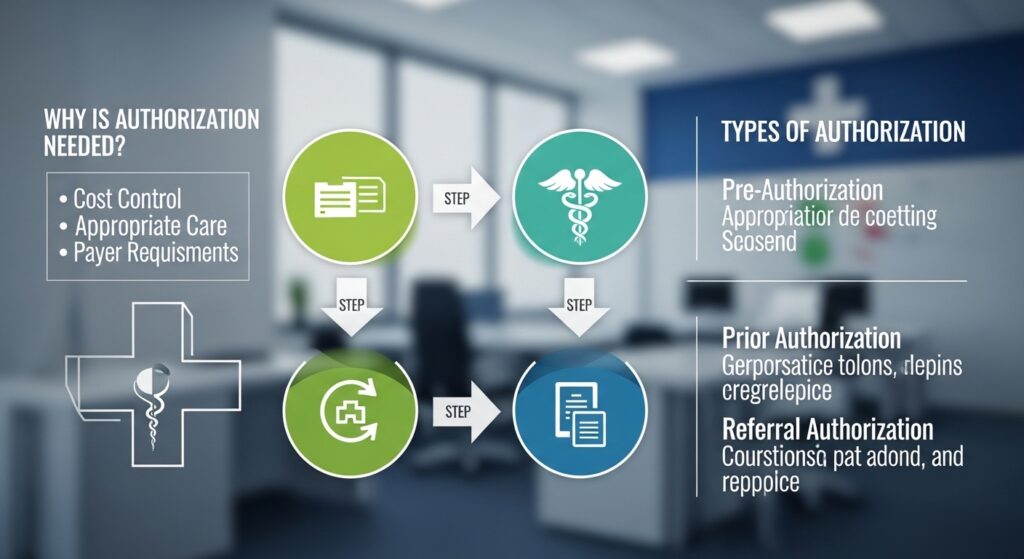
In the complex world of healthcare administration, few things are as critical, or as potentially frustrating as prior authorization. For patients, it can feel like a bureaucratic hurdle; for providers, it’s a rigorous administrative task.
However, understanding what authorization in medical billing is and how it functions is essential for ensuring that medical services are covered and that providers are reimbursed.
In this comprehensive guide, we will break down the mechanics of the authorization process, explore the different types of authorizations, and explain why an authorization number in medical billing is the “golden ticket” to a successful claim.
Understanding the Core: What is Authorization in Medical Billing?
At its simplest, prior authorization (also known as pre-certification or pre-authorization) is a requirement by health insurance companies that a provider must obtain approval before a specific service, drug, or medical device is delivered.
Think of it as a “pre-check” by the insurer. They want to verify that the proposed treatment is:
- Medically Necessary: Does the patient actually need this based on clinical guidelines?
- Cost-Effective: Is there a more affordable alternative that is equally effective?
- Covered: Is the specific procedure part of the patient’s insurance plan?
Without this “thumbs up” from the insurance company, the provider risks a claim denial, and the patient may be left with an unexpected and hefty bill.
The Step-by-Step Authorization Process
The authorization process isn’t just a phone call; it is a structured workflow that involves clinical documentation and administrative precision.
1. The Initial Recommendation
The process begins when a healthcare provider determines that a patient needs a specific procedure (like an MRI), a specialty medication, or a surgical intervention.
2. Verification of Benefits
The billing team checks the patient’s insurance policy to see if the recommended service requires prior authorization. Not every service requires it; routine office visits usually don’t, but high-cost services almost always do.
3. Submission of the Request
The provider’s office submits a formal request to the insurance carrier. This submission typically includes:
- Patient demographics and insurance ID.
- CPT Codes: Current Procedural Terminology (what is being done).
- ICD-10 Codes: International Classification of Diseases (why it is being done).
- Clinical Notes: Doctor’s notes, lab results, or imaging reports that justify the need for the service.
4. Insurance Review
The insurance company medical review team, often consisting of nurses or physicians, evaluates the request against their internal medical policies.
5. Determination
The insurer will issue one of three decisions:
- Approved: The service is cleared, and an authorization number is issued.
- Denied: The service is not approved. The provider can appeal this decision.
- Pended/More Info Needed: The insurer requires additional clinical data before making a choice.
What is an Authorization Number in Medical Billing?
Once a request is approved, the insurance company generates a unique alphanumeric code known as the authorization number.
This number is the most important piece of data for the billing department. When the medical coding claim is eventually submitted for payment, the authorization number must be included in the appropriate field (usually Box 23 on the CMS-1500 form).
Why is it so important?
- It acts as a reference: It links the performed service to the prior approval in the insurer’s system.
- It prevents “Administrative Denials”: Even if a procedure was medically necessary, a claim can be rejected simply because the authorization number was missing or entered incorrectly.
- It specifies a “Window”: Authorizations are usually time-bound (e.g., valid for 60 days) and specific to a certain provider or facility.
Common Types of Authorizations
Not all approvals are created equal. Depending on the insurance plan and the type of care, you may encounter different categories:
Prior Authorization
The most common type, required before the service is rendered. This is standard for elective surgeries, expensive prescriptions, and complex diagnostic imaging.
Pre-Certification
Often used interchangeably with pre-auth, but specifically refers to the process of notifying the insurer of a hospital admission or a surgical procedure. It ensures the facility stays are covered.
Retroactive Authorization
In some emergency cases, a service must be performed before approval can be sought. A retroactive authorization is requested after the service has occurred. These are notoriously difficult to get and require proof that the situation was an immediate threat to life or limb.
Referrals
While similar, a referral is slightly different. It is a formal document from a Primary Care Physician (PCP) stating that a patient needs to see a specialist. Many HMO plans require a referral before an authorization for a procedure can even be requested.
Real-World Examples of Authorization Requirements
To help visualize how this works in a clinical setting, let’s look at a few common scenarios:
Example 1: Diagnostic Imaging
A patient suffers from chronic migraines. The neurologist wants to order an MRI of the Brain. Because an MRI is a high-cost diagnostic test, the insurer requires prior authorization to ensure the doctor hasn’t skipped more affordable steps, like a CT scan or specific medications.
Example 2: Specialty Pharmacy
A patient with rheumatoid arthritis is prescribed a “Biologic” medication that costs $5,000 per month. The insurance company requires authorization to verify the patient has failed “Step Therapy” (cheaper drugs) before approving the expensive medication.
Example 3: Inpatient Surgery
A patient needs a total knee replacement. The surgeon must obtain authorization not just for the surgery itself, but also for the three-day stay at the surgical center.
Why Do Authorizations Get Denied?
Even with the best intentions, things can go wrong. Common reasons for denial include:
- Lack of Medical Necessity: The insurer believes the treatment is “experimental” or not supported by clinical evidence.
- Incomplete Information: Missing clinical notes or incorrect CPT codes.
- Out-of-Network Issues: The authorization was requested for a facility or doctor not in the patient’s network.
- Service Already Performed: Attempting to get a standard authorization after the procedure has already happened.
Best Practices for Authorizations Providers
For medical billing departments, managing authorizations efficiently is the key to maintaining a healthy revenue cycle.
- Start Early: Begin the process at least two weeks before the scheduled procedure.
- Use Digital Portals: Most insurers now have online portals that are much faster than faxing or calling.
- Document Everything: Keep a log of who you spoke to at the insurance company, the date, and any “reference numbers” given during the call.
- Verify the Authorization Number: Double-check that the number on the approval letter matches the one entered into the billing software.
- Patient Communication: Keep the patient informed. If an authorization is taking too long, the patient can often call their insurer to “nudge” the process along.
Future of Authorization: AI and Automation
The healthcare industry is moving toward Electronic Prior Authorization. By integrating the authorization process directly into Electronic Health Records (EHRs), the goal is to reduce the “administrative burden” on doctors and get patients their treatments faster. In the coming years, AI-driven tools will likely be able to predict whether a service will be approved instantly, reducing the wait time from weeks to seconds.
Conclusion
Authorization in HCC medical billing is the bridge between a doctor’s recommendation and an insurance company’s payment. While it adds a layer of complexity to healthcare, its purpose is to control costs and ensure that care follows established medical guidelines.
For patients, it provides the peace of mind that their insurance will foot the bill. For providers, securing that authorization number is the most vital step in the billing cycle. By staying organized, utilizing technology, and understanding the nuances of the process, medical practices can reduce denials and focus on what matters most: patient care.
