
If you’ve ever scheduled a specialist visit or a non-emergency procedure, there’s a good chance your doctor’s office had to call your insurance company before anything happened. That phone call, or online submission, is the start of something called prior authorization. It’s one of the most important (and often misunderstood) steps in the healthcare reimbursement process.
This guide breaks down everything you need to know about authorization in medical billing: what it is, why it exists, the types you’ll encounter, how the process works from start to finish, and what happens when it goes wrong.
Understanding Authorization in Medical Billing
At its core, authorization in medical billing is the formal approval process through which a healthcare provider obtains permission from a patient’s health insurance plan before delivering certain medical services, procedures, or medications.
Insurance companies use this process to verify that a requested service is medically necessary, covered under the patient’s plan, and being provided in the most cost-effective setting. Without this approval, the insurer may refuse to pay the claim, leaving the patient or provider holding the bill.
Authorization is also sometimes called:
- Prior authorization (PA)
- Pre-authorization
- Pre-certification
- Utilization review approval
These terms are often used interchangeably, though there are subtle distinctions between them in certain contexts (covered below).
Why Does Authorization Exist?
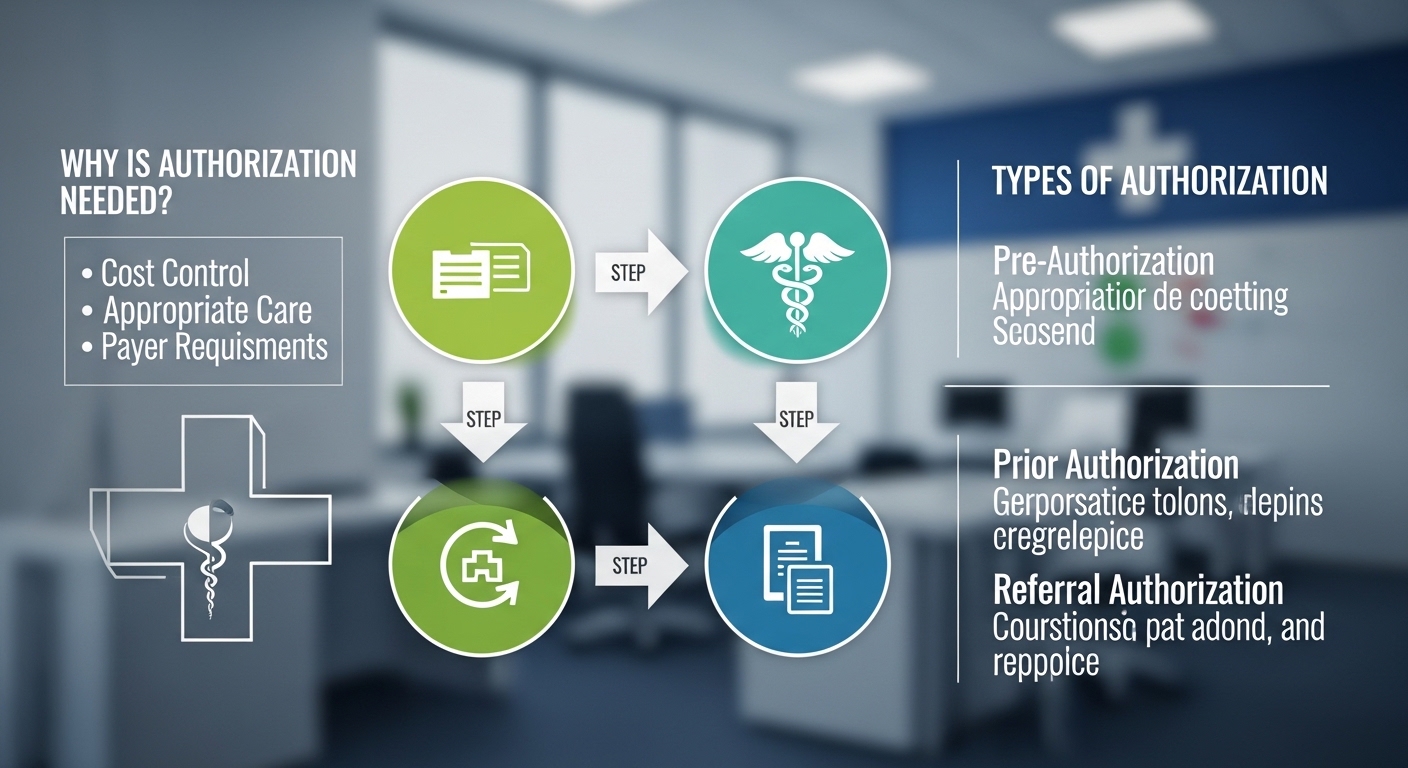
Health insurance companies developed authorization systems for a few key reasons:
Cost management. Insurers want to ensure they’re paying for treatments that are clinically appropriate and cost-effective. For example, they may require a patient to try a less expensive medication before approving a brand-name drug.
Medical necessity review. Not every service a doctor recommends is automatically covered. Authorization requires providers to demonstrate — through clinical documentation — that the service is medically necessary for that specific patient.
Fraud prevention. The authorization process creates a paper trail that helps insurers identify potentially fraudulent or unnecessary claims before payment is made.
Network compliance. Some authorizations also confirm that a service is being performed by an in-network provider or in an approved facility.
What is an Authorization Number in Medical Billing?
When an insurance company approves a request for a service, they issue an authorization number, a unique alphanumeric coding that confirms the approval.
This number is critically important. Here’s why:
- It serves as proof that the insurer reviewed and approved the service before it was rendered.
- It must be included on the claim form (usually the CMS-1500 for professional claims or the UB-04 for facility claims) when billing for that service.
- It protects the provider against claim denials related to lack of authorization.
- It gives the patient confidence that the service will be covered.
Medical billing specialists and front-desk staff are trained to record authorization numbers accurately and attach them to the correct patient account and service date. A missing or incorrect authorization number is one of the most common reasons a claim gets denied, even when the service itself was fully approved.
Where is the Authorization Number Used?
The authorization number appears in several key places:
- Electronic claims (EDI 837P/837I): In the appropriate loop and segment designated for authorization reference information.
- Paper claims (CMS-1500): In Box 23 (“Prior Authorization Number”).
- Patient records: Documented alongside the service for audit purposes.
- Remittance advice: Referenced when payment is confirmed or a denial is explained.
Types of Authorization in Medical Billing
Not all authorizations are the same. Depending on the type of service, the timing, and the insurer’s requirements, different types of authorization may apply.
1. Prior Authorization
This is the most common type. Prior authorization is obtained before a service is scheduled or performed. It’s required for a wide range of services, including:
- Elective surgeries (knee replacement, bariatric surgery)
- High-cost imaging (MRI, CT scans, PET scans)
- Specialty medications and biologics
- Durable medical equipment (DME) like wheelchairs or CPAP machines
- Mental health and substance use disorder treatment programs
- Home health services
- Referrals to out-of-network specialists
Example: A cardiologist recommends a cardiac catheterization for a patient. Before scheduling the procedure, the hospital’s authorization team submits clinical notes and diagnostic test results to the insurer. The insurer reviews the case and, within a few days, issues a prior authorization number approving the procedure.
2. Pre-Certification
Pre-certification is specifically used for inpatient hospital admissions, particularly planned (non-emergency) hospital stays. It confirms that the admission is medically necessary and that the facility is appropriate for the level of care needed.
Unlike a general prior authorization, pre-certification often involves an ongoing review process where the insurer may periodically review whether the patient still requires inpatient care (a process called concurrent review).
Example: A patient scheduled for a spinal fusion surgery needs pre-certification for a three-day inpatient hospital stay. The hospital submits the surgical plan and expected recovery timeline to the insurer, which approves the stay and sets an expected discharge date.
3. Concurrent Authorization
Once a patient is admitted to the hospital, the insurer may require concurrent authorization, ongoing approval for each additional day the patient remains hospitalized. This is especially common in managed care plans like HMOs.
A case manager or utilization review nurse at the facility communicates with the insurance company daily (or every few days) to justify continued inpatient care.
Example: After a hip replacement surgery, a patient is approved for three inpatient days. On day two, the care team determines the patient needs additional monitoring. The hospital’s utilization review team contacts the insurer, provides clinical justification, and receives concurrent authorization for one additional day.
4. Retrospective Authorization
Retrospective authorization is requested after the service has already been delivered, typically in emergency situations or when the provider failed to obtain authorization in advance.
Insurers may grant retroactive approval if the service was clinically necessary and the reason for the delay was outside the provider’s control (such as an emergency admission). However, retrospective authorizations are harder to obtain and are not guaranteed.
Example: A patient is rushed to the emergency room and requires emergency surgery. The surgeon proceeds without prior authorization. After the patient is stabilized, the billing department submits a request for retrospective authorization, supported by the emergency clinical documentation.
5. Referral Authorization
Referral authorization is used in HMO and gatekeeper-model insurance plans, where a primary care physician (PCP) must formally refer a patient to a specialist before the specialist visit is covered.
This type of authorization ensures care coordination and prevents patients from bypassing their primary care provider to access specialty services unnecessarily.
Example: A patient enrolled in an HMO plan wants to see a dermatologist for a skin condition. Their PCP submits a referral authorization to the insurer. Once approved, the patient can schedule the dermatologist appointment with confidence that it will be covered.
Prior Authorization Process: Step by Step
Understanding how the authorization workflow actually unfolds helps both providers and patients navigate the system more effectively.
Step 1: Identify Whether Authorization Is Required
Not every service needs authorization. Providers use payer-specific lists, sometimes called authorization matrices or preauthorization checklists, to determine whether a planned service requires advance approval. These lists vary by insurance company and plan type.
Routine office visits, preventive care, and emergency services typically do not require prior authorization.
Step 2: Gather Clinical Documentation
The provider’s team collects the clinical information needed to support the request. This typically includes:
- The patient’s diagnosis (ICD-10 code)
- The requested procedure or service (CPT code)
- Medical records, lab results, imaging reports
- Treatment history (e.g., prior medications tried)
- The physician’s clinical rationale for the requested service
Step 3: Submit the Authorization Request
The request is submitted to the insurer via one of several methods:
- Online portal (most common today)
- Phone call to the insurer’s utilization management department
- Fax (still used by some payers)
- Electronic transaction (the HIPAA-standard 278 transaction set)
Step 4: Insurer Review
The insurance company’s utilization management team, which may include nurses, pharmacists, or physician reviewers, evaluates the request against clinical coverage criteria. Commonly used criteria include InterQual and Milliman Care Guidelines.
Review timelines vary:
- Standard requests: 3–15 business days (varies by state law and plan type)
- Urgent requests: 24–72 hours
- Emergency situations: Retrospective review after the fact
Step 5: Decision Issued
The insurer issues one of three decisions:
- Approved: The service is covered. An authorization number is issued.
- Denied: The request doesn’t meet coverage criteria. A denial letter is sent with the reason.
- Pended (Additional Information Requested): The insurer needs more documentation before making a decision.
Step 6: Communicate Authorization to the Care Team
Once approved, the authorization number is recorded in the patient’s account. Front-desk staff, schedulers, and billing specialists all need access to this number before the service is performed and before the claim is submitted.
Step 7: Claim Submission with Authorization Number
When the service is performed, the claim is submitted with the authorization number included. This tells the insurer that the service was pre-approved, significantly reducing the likelihood of a denial based on lack of authorization.
What Happens When Authorization is Denied?
A denial doesn’t always mean the end of the road. Providers and patients have the right to appeal a prior authorization denial.
Common reasons for denial include:
- The service is not covered under the patient’s plan
- The documentation doesn’t meet medical necessity criteria
- The wrong level of care was requested
- The provider is out-of-network
The appeals process typically involves submitting additional clinical documentation, requesting a peer-to-peer review (where the treating physician speaks directly with the insurer’s medical reviewer), or filing a formal internal or external appeal.
Many states have enacted laws that set strict timelines for insurer responses to both initial authorization requests and appeals, helping to protect patients from excessive delays.
Authorization vs. Eligibility vs. Benefits Verification
These three terms often come up together in medical billing, but they mean different things:
| Term | What It Confirms |
| Eligibility Verification | Whether the patient is currently enrolled in an active insurance plan |
| Benefits Verification | What services are covered, what the deductible/copay is, network status |
| Authorization | Whether a specific service has been pre-approved for reimbursement |
All three steps are ideally completed before a patient’s appointment or procedure. Skipping any one of them increases the risk of a claim denial or unexpected patient liability.
Common Challenges in the Authorization Process
The prior authorization process, while necessary, is not without its frustrations. Healthcare providers, patients, and policymakers have all raised concerns about:
Administrative burden. Studies have found that physicians and their staff spend significant time each week on authorization-related tasks, pulling resources away from direct patient care.
Treatment delays. Waiting for authorization can delay medically necessary care, which in some cases leads to worse patient outcomes.
Lack of transparency. Insurers’ coverage criteria are not always publicly available, making it difficult for providers to anticipate what will or won’t be approved.
Inconsistency. The same service may be approved by one insurer and denied by another, creating confusion for both patients and providers.
Efforts to reform the prior authorization process are ongoing at both the federal and state levels, including legislation that would require insurers to use electronic authorization systems and establish stricter timelines for reviews.
Tips for a Smooth Authorization Process
Whether you’re a billing specialist, a healthcare provider, or a patient trying to understand your coverage, these practices help reduce authorization-related headaches:
- Always verify authorization requirements before scheduling a non-emergency procedure or specialist visit.
- Document everything. Keep records of when authorization was requested, who reviewed it, and any reference numbers provided.
- Know the expiration date. Authorizations are valid for a specific timeframe (often 90 days to one year). If a service is delayed, a new authorization may be required.
- Appeal denials promptly. Most plans have strict deadlines for filing appeals, missing them forfeits the right to appeal.
- Use peer-to-peer reviews. If a denial seems clinically unjustifiable, a direct conversation between the treating physician and the insurer’s medical reviewer often leads to a reversal.
Final Thoughts
Authorization in medical billing is more than an administrative formality, it’s a process that directly affects whether healthcare providers get paid and whether patients receive timely care. Understanding the types of authorization, how to obtain them, what authorization numbers mean, and how to navigate denials empowers everyone involved to work the system more effectively.
For billing teams, mastering the authorization workflow means fewer claim denials and faster reimbursement. For patients, understanding why authorization is required, and what to do when it’s denied, means less stress and more confidence in navigating the healthcare system.
As healthcare continues to evolve, so does the authorization landscape. Staying informed about payer requirements, regulatory changes, and best practices remains essential for anyone working in or interacting with the medical billing world.
