
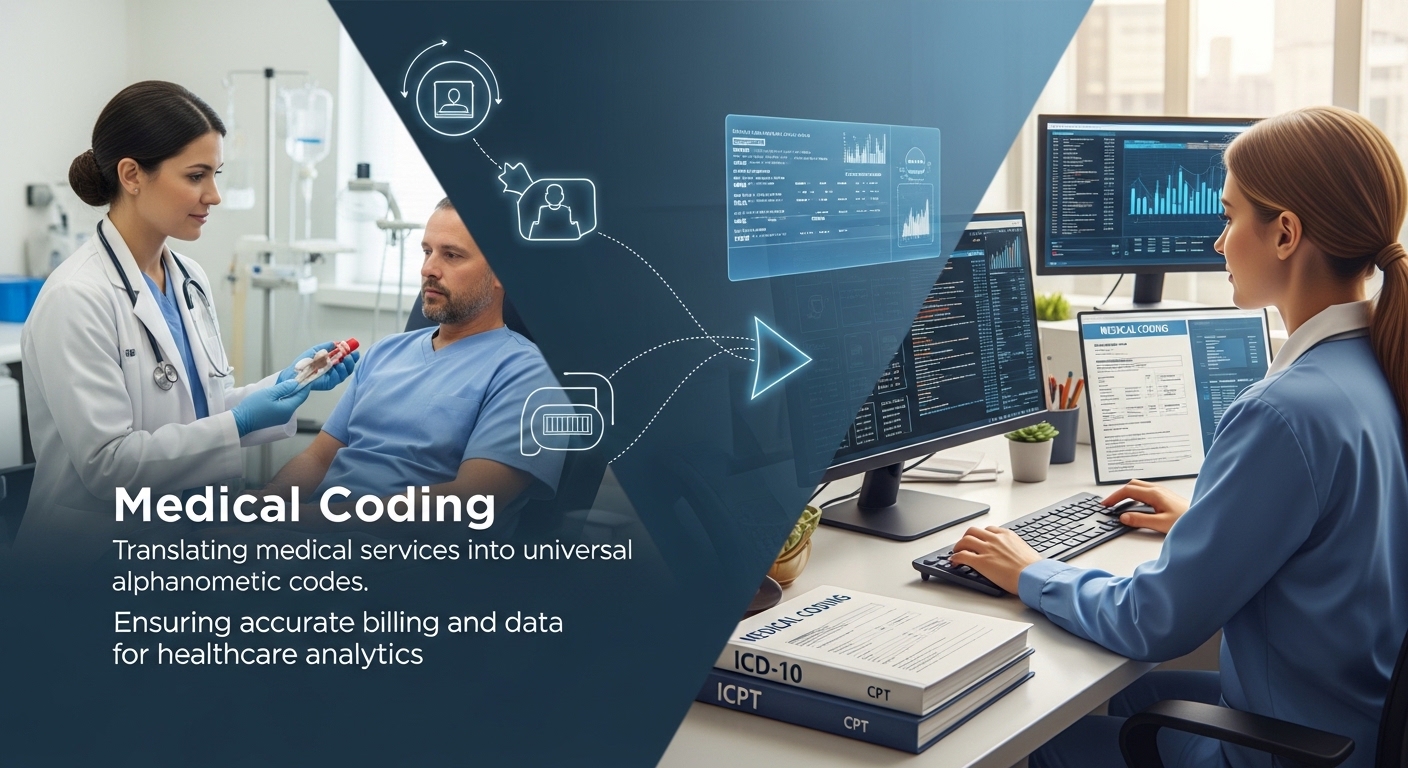
Every time you visit a doctor, undergo surgery, or fill a prescription, a chain of behind-the-scenes activity is set in motion, long before any bill reaches your mailbox.
At the heart of that process is something most patients never think about: medical coding. It is one of the most critical yet least-understood functions in modern healthcare.
This guide breaks down what medical coding is, why it exists, how it works, and why it matters, not just too healthcare professionals, but to every single person who has ever walked into a clinic or hospital.
What is Medical Coding? The Core Definition
Medical coding is the process of translating healthcare diagnoses, procedures, medical billing services, and equipment into standardized alphanumeric codes.
These codes are drawn from globally recognized classification systems and serve as a universal language between healthcare providers, insurance companies, and government health programs.
Medical coding is not guesswork. It requires a deep knowledge of anatomy, pharmacology, disease pathology, medical terminology, and the ever-evolving rules of coding guidelines. It is both a science and an art.
What Is a Medical Coder? The Person behind the Code
A medical coder is a healthcare professional who reviews clinical documentation, including physician notes, lab reports, operative reports, and discharge summaries, and assigns the appropriate standardized codes to every diagnosis, procedure, and medical service documented.
Medical coders do not work directly with patients. Instead, they operate in the background, working closely with physicians, nurses, billing departments, and insurance companies to ensure that every medical encounter is accurately captured in code form.
Where Do Medical Coders Work?
Medical coders are employed in a wide variety of settings, including:
- Hospitals and health systems (inpatient and outpatient departments)
- Physician private practices and group clinics
- Outpatient surgical centers
- Telehealth and remote healthcare companies
- Insurance and managed care organizations
- Government health agencies such as Medicare and Medicaid
- Medical billing companies and revenue cycle management firms
With the rise of remote work in healthcare administration, a growing number of coders now work from home, making it one of the more flexible careers in the medical field.
What is a Medical Code? Breaking Down the Systems
A medical code is a short, standardized identifier, typically a combination of letters and numbers, that represents a specific diagnosis, procedure, service, or piece of equipment.
Each code has a precise definition, and using the wrong one can result in claim denials, audits, or even accusations of fraud.
There are several major coding systems in use today, each serving a distinct purpose:
1. ICD-10-CM — Diagnosis Coding
The International Classification of Diseases, 10th Revision, Clinical Modification (ICD-10-CM) is used to code patient diagnoses. It contains over 70,000 codes and is maintained by the World Health Organization, with the U.S. clinical modifications managed by the Centers for Medicare & Medicaid Services (CMS).
Example: J18.9 is the code for unspecified pneumonia. The letter indicates the body system (J = respiratory), and the numbers provide increasing specificity.
2. CPT Codes — Procedure Coding
Current Procedural Terminology (CPT) codes are maintained by the American Medical Association and are used to describe medical, surgical, and diagnostic procedures and services. There are over 10,000 CPT codes, and they are essential for outpatient and physician billing.
Example: CPT code 99213 represents an office visit with a physician for an established patient, a moderate-complexity evaluation and management service.
3. ICD-10-PCS — Inpatient Procedure Coding
The International Classification of Diseases, 10th Revision, Procedure Coding System (ICD-10-PCS) is used exclusively for inpatient hospital procedure coding. Unlike CPT, it is a seven-character alphanumeric system with over 78,000 codes.
4. HCPCS Level II — Products, Supplies & Services
Healthcare Common Procedure Coding System Level II codes are used for items and services not covered by CPT, including durable medical equipment, ambulance services, medications administered in a clinical setting, and more. These codes begin with a letter (A–V) followed by four digits.
What is the Purpose of Medical Coding?
Understanding why medical coding exists helps explain just how foundational it is to the entire healthcare ecosystem. The purpose of medical coding extends far beyond simply sending a bill. Here are the key reasons medical coding is essential:
1. Accurate Insurance Reimbursement
This is the most visible function of medical coding. For any healthcare provider to receive payment from an insurance company, whether private, Medicare, or Medicaid, the services rendered must be translated into codes. The insurer uses these codes to determine how much to reimburse the provider. Without accurate coding, providers would not get paid for the care they deliver.
2. Maintaining Medical Records
Coding in medical records creates a standardized, permanent record of every diagnosis and procedure a patient has experienced. These records are used by future treating physicians, specialists, and emergency providers to understand a patient’s complete health history at a glance.
3. Supporting Public Health Research
On a population level, aggregated coding data is used by governments, research institutions, and global health organizations (including the World Health Organization) to track disease patterns, monitor the spread of illness, allocate resources, and plan public health policy. The COVID-19 pandemic response relied heavily on coding data to understand infection and mortality trends.
4. Legal and Compliance Documentation
Coded medical records serve as legal documentation of care. In cases of malpractice litigation, insurance disputes, or governmental audits, the coded record stands as the official account of what was diagnosed and treated. Accurate coding protects both the patient and the provider.
5. Enabling Healthcare Analytics
Hospitals and health systems use coded data to measure outcomes, identify high-cost conditions, evaluate physician performance, reduce unnecessary procedures, and improve care quality. Medical coding is the raw data layer that powers modern healthcare analytics and hospital strategy.
What is Coding in Medical Billing?
Medical billing and medical coding are closely related but are distinct functions. Medical coding is the clinical translation process, converting documentation into codes. Medical billing is the business process, using those codes to submit claims to insurance companies and collect payment.
Here is how the two work together in the revenue cycle:
- Step 1 — Patient Visit: The patient receives care, and the physician documents everything in the patient’s record.
- Step 2 — Coding: The medical coder reviews the documentation and assigns appropriate diagnosis and procedure codes.
- Step 3 — Charge Capture: The codes are used to calculate the appropriate charges for each service.
- Step 4 — Claim Submission: The medical biller submits a claim to the patient’s insurance company, including all relevant codes.
- Step 5 — Adjudication: The insurer reviews the claim, verifies the codes, and determines the reimbursement amount.
- Step 6 — Payment and Follow-Up: The provider receives payment; any underpayments or denials are appealed by the billing team.
In this pipeline, a single coding error — a wrong digit, a mismatched code, or a missing modifier — can delay payment for weeks or trigger an audit. This is why accuracy in medical coding is not optional; it is mission-critical.
What is a Coder in a Hospital?
In a hospital setting, medical coders play a particularly complex and high-stakes role. Hospital coding differs from physician office coding in several key ways. Hospitals must code both the clinical (physician) side and the facility (hospital) side of every encounter, each requiring different code sets and guidelines.
Hospital coders typically specialize in one of the following areas:
Inpatient Coders
These specialists code patient stays that involve at least one overnight admission. They use ICD-10-CM for diagnoses and ICD-10-PCS for procedures. Inpatient coding requires identifying the principal diagnosis (the condition chiefly responsible for the admission), all secondary diagnoses, and all significant procedures performed during the stay. The complexity here directly impacts the hospital’s Diagnosis-Related Group (DRG) assignment, which determines how much Medicare pays for the entire admission.
Outpatient and Emergency Coders
These coders handle visits that do not result in an overnight stay, including emergency department encounters, same-day surgeries, and clinic visits. They use ICD-10-CM alongside CPT and HCPCS codes. Outpatient coding is governed by a different set of guidelines than inpatient, and coders must be trained accordingly.
Specialty Coders
Large hospital systems often employ coders who specialize in specific clinical areas, cardiology, oncology, orthopedics, obstetrics, or neurology, for example. These specialty coders develop deep expertise in the anatomy, procedures, and coding conventions unique to their clinical area, reducing errors and maximizing appropriate reimbursement.
Skills, Credentials, and Career Path
Becoming a medical coder typically requires formal education in health information management, medical billing, or a related field, combined with professional certification from a recognized credentialing body.
Common Misconceptions About Medical Coding
There are several widespread myths about medical coding that are worth addressing, especially for those considering it as a career or trying to understand their medical bills.
Myth 1: Medical Coding is Just Data Entry
This is perhaps the most pervasive misconception. Medical coding requires clinical knowledge, critical thinking, and analytical judgment. Coders must understand complex medical documentation, interpret ambiguous physician notes, apply nuanced coding guidelines, and stay current with annual code updates. It is skilled professional work, not clerical data entry.
Myth 2: Anyone Can Learn It Quickly
While online certification programs have made entry into the field more accessible, becoming a proficient coder takes time. Most industry experts recommend gaining practical experience under supervision before coding independently, especially for complex inpatient cases.
Myth 3: Coding and Billing Are the Same Job
As explained earlier, coding and billing are related but distinct roles. Some small practices combine the two, but in larger organizations, they are separate departments with different responsibilities, training requirements, and skill sets.
Future of Medical Coding in 2026 and Beyond
Medical coding is evolving rapidly, driven by advances in artificial intelligence, natural language processing, and the adoption of more sophisticated electronic health record systems. Computer-assisted coding (CAC) software now helps coders by automatically suggesting codes based on clinical documentation, but human review and oversight remain essential to ensure accuracy and compliance.
The ICD-11 transition is also on the horizon for the United States. While ICD-10 continues to be the standard domestically, ICD-11 (already adopted by the World Health Organization and several countries) offers greater granularity and improved clinical detail. A future U.S. transition would represent the most significant change in diagnostic coding since ICD-10 was implemented in 2015.
Despite automation, demand for skilled medical coders remains strong. The U.S. Bureau of Labor Statistics projects steady employment growth in health information management, and experienced coders, particularly those with specialty expertise or audit skills, remain highly valued in the industry.
AI and automation are changing the tools coders use, but they are not replacing the need for human expertise. Clinical judgment, compliance knowledge, and quality oversight will keep experienced coders in high demand well into the future.
Conclusion: Why Medical Coding is the Backbone of Healthcare
Medical coding may operate in the background, invisible to most patients, but its impact is felt throughout the entire healthcare system. It determines whether providers get paid, whether medical records are accurate, whether researchers have the data they need, and whether health systems can measure and improve the care they deliver.
From the moment a physician documents a patient encounter to the final insurance reimbursement, medical coders ensure that clinical language is transformed into a standardized, universal format that drives the business and science of healthcare.
Whether you are a student considering a career in health information management, a patient trying to understand your Explanation of Benefits, or a healthcare administrator looking to improve your revenue cycle, understanding what medical coding is and how it works is an essential first step.
